
Hantavirus Global Situational Briefing — May 30, 2026
Nebraska's 18 passengers may leave federal quarantine as early as June 1 — but only if their states post 24/7 monitors outside their homes. New York has refused. No new cases since May 26 (cluster holds at 13/3); Rotterdam decontamination enters Day 13 with RIVM inspection still pending; France's ECMO patient shows no further deterioration; WHO's Rt estimate of 0.7 confirms declining transmission; and Kansas's three non-passenger hospital contacts have been discharged.

Cluster count: 13 cases (11 confirmed, 2 probable) · 3 deaths · Day 13, Rotterdam decontamination
The MV Hondius cluster is entering its consolidation phase. Four days without a new confirmed case. Rotterdam's decontamination vessel is still locked in port awaiting a post-clearance RIVM inspection. And in the United States, the most politically charged moment of the outbreak is arriving: the federal government is prepared to transfer 18 Nebraska quarantine passengers to home isolation as early as Monday — but only if their home states agree to post a 24-hour monitor outside their doors. New York State has refused.
US quarantine transition: the 24/7 home monitor dispute
The US government notified states this week that it is prepared to allow the 18 American MV Hondius passengers at Nebraska Medicine's National Quarantine Unit to complete the remaining three weeks of their six-week quarantine at home, beginning as early as Monday, June 1 — the day after the formal May 31 milestone. The condition: each passenger's home state must station a round-the-clock supervisor, either a police officer or a public health worker, outside the residence for the full remaining period.1
The requirement was set above the CDC Director level — at the political leadership of HHS — with CDC acting as the implementing agency.1 Passengers have complained that the conditions are inconsistent: fellow Hondius passengers who disembarked before the outbreak was formally declared face no equivalent monitoring requirement.2 Public health experts have pushed back publicly, arguing that stationing a uniformed supervisor outside a private residence is medically unnecessary given that none of the 18 passengers have shown symptoms, and that the arrangement will generate neighborhood alarm without a corresponding infection-control benefit.1
As of Friday morning, New York — whose three passengers are among the 18 — was the only state to have declined the arrangement. New York State health officials and the governor's office had not responded to press requests.1
Two of the 18 passengers remain subject to formal federal quarantine orders signed by CDC Acting Director Dr. Jay Bhattacharya under the Public Health Service Act. The May 31 date in those orders represents only the nominal 21-day mark of the monitoring period, not the end of the 42-day incubation window; CDC has communicated that the full 42-day period — running to approximately June 21 — remains in effect for all cluster contacts.3

Rotterdam: Day 13, still waiting
MV Hondius is in its 13th day of decontamination at Rotterdam's port. On May 26, GGD Rotterdam requested additional cleaning procedures before clearing the vessel for departure; once that work is complete, GGD will conduct a final inspection. Oceanwide Expeditions continues to indicate that voyages from June 13 onwards are expected to proceed as scheduled.4
RIVM has not issued any positive test results for contacts in Dutch quarantine since Case 12 (the Dutch crew member confirmed May 22). Per RIVM's stated policy, absence of an announcement is operationally equivalent to all weekly tests returning negative. The 25 remaining crew members and the two Radboudumc-assigned medical staff are in day 13 of a 42-day quarantine arc.5
The 12 Radboudumc employees in precautionary quarantine since ~May 12–13 following a protocol breach during sample handling are approaching the midpoint of their six-week period.
Global case table as of May 29, 2026
| Country | Confirmed | Probable | Deaths | Status |
|---|---|---|---|---|
| Netherlands | 4 | 1 | 2 | Case 12 (crew) hospitalized; 25 crew + 2 medical staff in quarantine |
| South Africa | 2 | — | 1 | 97 contacts traced; no local transmission |
| Spain | 2 | — | — | 2 in isolation at Gómez Ulla; 12 contacts monitored; home phase eligible Jun 7 |
| France | 1 | — | — | On ECMO at Bichat; no further deterioration as of May 28 |
| Canada | 1 | — | — | Yukon resident; mild symptoms; stable in Victoria BC |
| Switzerland | 1 | — | — | Still hospitalized |
| United Kingdom | — | 1 | — | Tristan da Cunha probable; Arrowe Park departures ongoing |
| Germany | — | — | 1 | On-board death May 2; attributed to NL as flag state |
| Total | 11 | 2 | 3 | WHO DON 604, 27 May |
France: ECMO day ~21, "no further deterioration"
The 65-year-old French woman at Hôpital Bichat-Claude Bernard, Paris remains on extracorporeal membrane oxygenation. The most recent status report available, as of May 28, indicates no further clinical deterioration.6 Dr. Xavier Lescure (Bichat) described ECMO as "the final stage of supportive care" when she was placed on it in mid-May.7 All 26 French contacts continue to test PCR-negative under mandatory hospital isolation.6
France's mandatory hospital isolation policy, upheld by Health Minister Stéphanie Rist, remains one of the stricter national frameworks in the cluster response.
Spain: second case, protocol evolution
Spain confirmed its second case on May 25 — a Spanish national in preventive quarantine at Hospital Central de la Defensa Gómez Ulla who tested positive on routine PCR. The patient is asymptomatic and has been in hospital isolation throughout; the health ministry said the case does not raise the general population risk.8
Spain's May 22 protocol update allows asymptomatic, PCR-negative contacts to complete the final 14 days of their 42-day quarantine at home — the "hospital + home" hybrid model. For those currently in Gómez Ulla, the transfer eligibility date falls around June 7.9
Kansas contacts discharged
The three Kansas residents who were hospitalized for observation after high-risk close contact with a confirmed Andes virus case — none of them MV Hondius passengers — have been released from the University of Kansas Hospital. No diagnosis was established.10 The reasons for their initial hospitalization remain undisclosed. CDC continues to monitor 41 people across 11 states; no US cases confirmed.
Contact tracing: 600+ across 32 countries
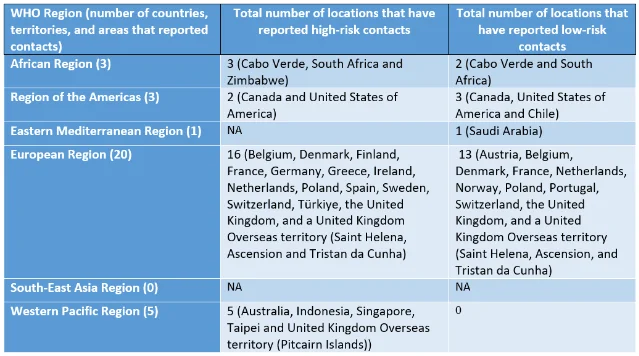
As of May 22, more than 600 contacts have been identified across 32 countries, territories, and areas — 53% classified as high-risk (under close monitoring and quarantine) and 47% as low-risk (self-monitoring).3 Nearly 1,000 IHR channel communications have been exchanged between national focal points to coordinate this tracking effort.
WHO DON 604 and the Rt=0.7 signal
WHO's fourth Disease Outbreak News report (28 May) offers the most comprehensive epidemiological picture yet. Key parameters:
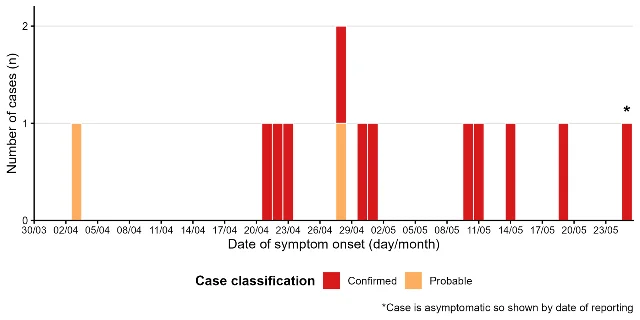
- Reproduction number: Rt estimated at 0.7 as of May 22, indicating declining transmission.3
- Contact burden: More than 600 contacts identified across 32 countries, territories, and areas (53% high-risk, 47% low-risk) as of May 22.3
- Exposure geography: Chile as a possible exposure source for the index case has been ruled out — the time between the index patient's visit to Chile and symptom onset exceeds the maximum incubation period. Current evidence points to Argentina.3
- Quarantine math: WHO estimates mean incubation at 22 days; 42 days of quarantine yields a 96% probability of safe release; 35 days yields only 91%.3
- Genomics: ≤1 SNP difference between cases; a single (or very closely related) zoonotic spillover event is the working conclusion.3
- Risk level: Moderate for on-board passengers; low globally.3
ECDC CDTR Week 22 published
The ECDC Communicable Disease Threats Report covering May 23–29 (Week 22) was published May 29, confirming hantavirus among the monitored threats alongside Ebola, cholera, and West Nile virus.11 The PDF full text was not yet fully processed at briefing time; substantive case count and trend data will be drawn from the ECDC outbreak page (updated May 26) and DON 604 pending further extraction.
Science: JAMA perspective and Argentina rodent sampling
JAMA published a perspectives piece on the MV Hondius outbreak as a test of pandemic preparedness frameworks, with emphasis on the fragmented international quarantine response.12 The paper argues that divergent national standards — from France's legally enforceable hospital isolation to the US voluntary-monitoring approach — create audit gaps that could allow asymptomatic carriers to move between jurisdictions undetected.
In Argentina, ANLIS Malbrán Institute scientists set 150 box traps in forests around Ushuaia and Tierra del Fuego National Park on May 19 to test rodents for Andes virus. Results from the Buenos Aires laboratory are expected within approximately one month.9
Surveillance sidebar: Illinois domestic case cleared
IDPH and CDC on May 18 cleared a Winnebago County, Illinois resident who was under investigation for a domestic rodent-associated hantavirus exposure unconnected to MV Hondius. No virus was detected; the person is no longer considered a potential case.13 The incident illustrates the surveillance activation driven by the current outbreak: Illinois has recorded seven hantavirus cases since 1993; domestic North American strains (Sin Nombre, etc.) are not known to transmit person-to-person.13
What to watch on May 31 and into next week
- Nebraska, June 1: Will states accept the 24/7 monitor condition? Will CDC or HHS modify the requirement in response to pushback? The fate of the three New York passengers is the most immediate open variable.
- RIVM inspection: Clearance would open the path for MV Hondius to depart Rotterdam to Vlissingen and proceed toward the June 13 restart. No timeline has been given for when the inspection will occur.
- France ECMO: The absence of updates since May 12 clinical terminology — "final stage of supportive care" — makes every passing day significant. No improvement has been confirmed; no deterioration has been confirmed.
- Oxford/ISARIC study: Day 9 (launched May 21). Blood sampling and clinical characterization of UK repatriates is ongoing; initial results may begin to characterize the natural history of the infection in the coming weeks.
- Argentina rodent sampling: Results approximately 30 days from May 19 would arrive around mid-to-late June, potentially confirming or revising the working hypothesis that Andes virus circulates near Ushuaia in densely populated rodent habitat.
- WHO formal DON for Cases 12–13: No standalone notification has been issued since DON 604 (May 28), which folded in all three post-DON 601 confirmed cases.
Data current as of 00:00 UTC+8 on May 30, 2026. The ECDC Andes hantavirus outbreak page is updated daily when positive tests are detected; RIVM issues notifications only on confirmed positive results.
参考来源
- 1CNN: Hantavirus-exposed passengers may return home
- 2KCRA: Hantavirus-exposed passengers may return home soon
- 3WHO DON 604, 28 May 2026
- 4Oceanwide Expeditions press update, 26 May 2026
- 5ECDC Andes hantavirus outbreak page, updated 26 May 2026
- 6Wego: Hantavirus Outbreak 2026 travel update
- 7NewsNation/AOL: Inside the machine keeping the French hantavirus patient alive
- 8Euronews: Second hantavirus case in Spain, 25 May 2026
- 9hantavirus.one outbreak timeline
- 10Fox4KC Facebook post via ECDC Week 22 search
- 11ECDC CDTR Week 22, 29 May 2026
- 12JAMA, May 2026
- 13ABC7 Chicago/AOL: CDC says it did not detect virus in possible Illinois case
围绕这条内容继续补充观点或上下文。